
|
A Thousand Arrows: Why I Had to Write Culture 4.0

A Thousand Arrows: Why I Had to Write Culture 4.0
Blog post by John R Childress
A year and a half ago, I had lunch with a former client who recently retired as CEO of a multibillion-dollar aerospace and defense company. Over the course of his career, he navigated recessions, geopolitical upheavals, and the relentless pressure of shareholder expectations. He was sharp, reflective, and thoroughly glad to be out of the corner office.
At some point during our conversation, he leaned back and said something that has stayed with me ever since.
“John, I am so glad I am retired. I don’t know how today’s CEOs manage. It feels like they are standing in the open, facing a thousand arrows coming at them all at once.”

He then proceeded to list them. Artificial intelligence is rewriting entire business models almost overnight. The unresolved tensions of hybrid and remote work. Social media amplifies every corporate misstep into a global story within hours. Cybercrime treats corporate data as a commodity to be harvested or held hostage. A Generation Z workforce with values and expectations that many organizations still do not fully understand. An aging workforce is delaying retirement and reshaping succession pipelines. Climate change and sustainability moving from boardroom aspiration to regulatory imperative. Shifting geopolitical realities disrupting supply chains and global strategies. Growing regulatory complexity is piling new obligations on already-stretched compliance functions. And underneath all of it, persistent fissures around conservatism, gender dynamics, workplace divisions, and behaviors that erode trust and cohesion.
He was not exaggerating. Add to that list the evolving dynamics of entrepreneurism and consumer power, the complex questions around outsourcing, immigration, and globalization, and the quiet crisis in middle management and frontline supervision, and you have a picture of organizational life that is genuinely without precedent in its scope and simultaneity.
The following day, I decided I had to use my four decades of leadership and culture advisory work to try to provide some solutions.
A Year of Research
Culture 4.0: The Future of Corporate Culture is the result of more than a year of research into each of these forces: what they are, how they are reshaping the relationship between organizations and the people who work in them, and, critically, what the most forward-thinking companies are actually doing to respond. The research was, at times, exhausting. Every topic opened into a vast landscape of evidence, debate, and experimentation. But the exhaustion was also energizing, because patterns began to emerge that no single headline ever captures.
The book is organized in two sections, and I believe both will bring insight, clarity and some solutions for leaders everywhere.
Section One: The World Has Changed. Is Your Culture Fit-for-Purpose?
The first section of Culture 4.0 works through the major external forces shaping organizational life today. Each chapter examines one of these forces in depth: what it means for people and organizations, where companies are getting it wrong, and where savvy leaders are finding their footing. The goal is not a catalog of threats. It is an honest reckoning with the new operating environment, grounded in real examples, and designed to help leaders move from anxiety to informed action.
Some of the stories are cautionary. Others are genuinely inspiring. What they share is a refusal to treat culture as something separate from strategy, operations, or the world outside the office walls.
The most common mistake organizations make is treating culture as an employee engagement issue rather than an organizational performance system.
Section Two: A New Model of Corporate Culture
The second section of the book is where I believe Culture 4.0 makes its most distinctive contribution. For decades, the dominant conversation about corporate culture has focused on employee attitudes, engagement scores, trust indices, and satisfaction surveys. These are treated as the culture itself.
They are not. They are outcomes. They are the symptoms of the corporate culture ecosystem. And when organizations try to improve culture by targeting the symptoms directly, they get, at best, temporary movement in the numbers and no lasting change in how people actually behave or what results they actually produce.
Culture 4.0 proposes a different model: one that treats corporate culture as an ecosystem of causal factors that together shape employee attitudes and actions. The diagram below illustrates the core of new understanding.
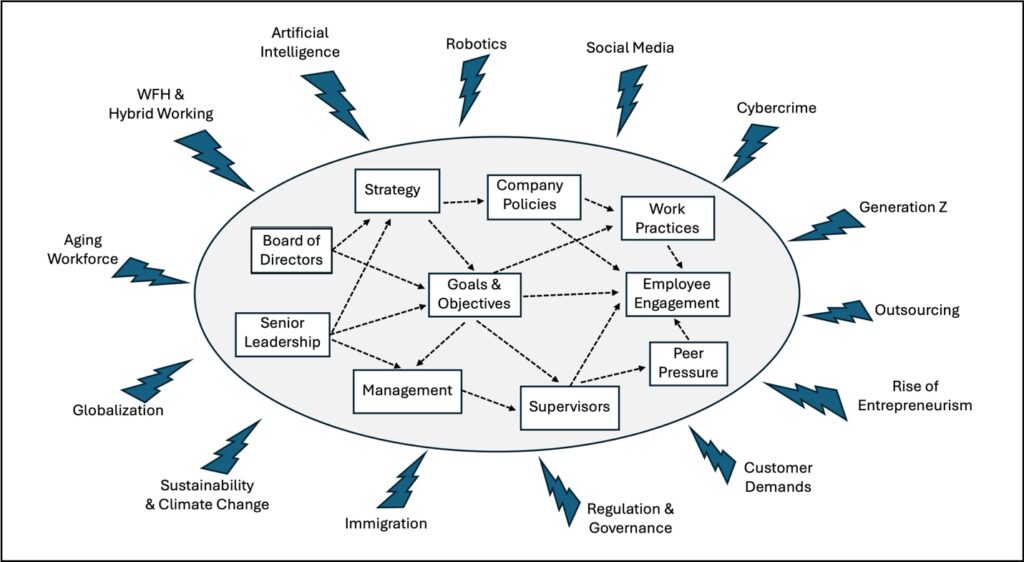
Figure 1: The Culture 4.0 Ecosystem Model. External forces (represented by the lightning bolts surrounding the organization) exert pressure on the internal causal factors that actually drive employee engagement and behavior.
The model shows that the organization is not a sealed environment. It sits within a field of external forces, each exerting pressure on the internal factors that shape how people think, feel, and act at work. These internal factors include the Board of Directors, Senior Leadership, Strategy, Company Policies, Goals and Objectives, Management, Supervisors, Work Practices, and Peer Pressure. Each of these connects to and influences the others in a dynamic ecosystem of causal relationships. The ability of the organization to deliver on its strategic, employee and customer commitments is determined by how well or poorly these internal factors are aligned, healthy, and functioning under external pressures.
The practical implication of this model is significant. If you want to change culture, you must work on the causal factors, not the symptoms. You must understand which parts of the ecosystem are under the greatest strain from which external forces, and leaders must intervene with precision rather than broad-brush engagement initiatives. This is the architecture that Culture 4.0 lays out in its second half: a diagnostic framework and a set of practical principles for rebuilding culture from the inside out, in a world where the arrows keep coming.
“Don’t say our people are disengaged. Tell the truth.
We have a cultural ecosystem that creates disengaged people.”
Who This Book Is For
Culture 4.0 is written for CEOs and board members who know the world has changed and suspect their culture has not kept pace. It is for HR leaders who are tired of defending engagement survey scores that no one trusts. It is for management consultants who want a more rigorous diagnostic lens. And it is for any leader, at any level, who has looked at their organization and felt, however dimly, that the culture they have is not the culture they need.
My retired CEO friend was right that today’s leaders face a daunting array of forces. But the organizations that will thrive in this environment are not the ones that simply endure those forces. They are the ones that build cultures resilient and adaptive enough to harness them.
That is what Culture 4.0 is about.
Culture 4.0: The Future of Corporate Culture is published by LID Publishing and is available in the UK from April , 23, 2026) and in the US from June 23, 2026. [Purchase links to be added]
Keywords: corporate culture, Culture 4.0, leadership, organizational change, employee engagement, culture transformation, future of work
#Culture40 #CorporateCulture #Leadership #FutureOfWork #OrganizationalChange #EmployeeEngagement #CultureTransformation #CEOInsights
About the Author
John R. Childress is a leadership advisor, corporate culture consultant, and author with four decades of experience advising Fortune 500 and FTSE 250 boards and executive teams. He is co-founder of the Senn-Delaney Leadership Consulting Group and Chairman of Pyxis Culture Technologies. Culture 4.0: The Future of Corporate Culture is published by LID Publishing (UK April 2026, US June 2026). Learn more at www.johnrchildress.com.